zeroQas
  • Blog

Iceberg model examples

8/16/2023

0 Comments

 
Iceberg model examples


A high IDV score indicates loose connections.

  • This refers to the strength of the ties people have to others within the community.
  • Application: According to Hofstede's model, in a high PD country such as Malaysia (104), you would probably send reports only to top management and have closed-door meetings where only select powerful leaders were in attendance.
  • Interestingly, his research was done on employees of IBM only, which allowed him to attribute the patterns to national differences in culture, largely eliminating the problem of differences in company culture. Armed with a large database of cultural statistics, Hofstede analyzed the results and found clear patterns of similarity and difference amid the responses along these five dimensions. The higher the score, the more that dimension is exhibited in society. Later he added a fifth dimension, and that is how the model stands today.He scored each country using a scale of roughly 0 to 100 for each dimension. He initially identified four distinct cultural dimensions that served to distinguish one culture from another.
  • How can we understand cultural differences? Are we relegated to learning from our mistakes, or are there generalized guidelines to follow?With access to people working for the same organization in over 40 countries of the world, Hofstede collected cultural data and analyzed his findings.
  • Thus climate can be understood as a surface manifestation Practices, and procedures, and subsequent patterns of interactions and behaviors
  • Organizational climate represent employees’ perceptions of organizational policies,.
  • Organizational culture is defined as a set of shared values and norms held byĮmployees that guide their interactions with peers, management, and clients.
  • Individuals’ behaviour either positively or negatively. The shared perceptions, feelings and attitudes organisational members have about theįundamental elements of the organisation which reflect theĮstablished norms, values and attitudes of the organisation’s culture and influence It reflects theĮxtent to which members of a society attempt to cope with anxiety by minimizing uncertainty

    iceberg model examples

    Uncertainty avoidance is a society’s tolerance for uncertainty and ambiguity. Society members view themselves as equals. Low PD means that power is shared and well dispersed. This refers to the degree of inequality that exists – and is accepted – among people with and Japan: though contracts (business contracts) writing do exist still it is practiced in a Spouse’s occupation, etc., in a job interview. US: Illegal to ask any candidate’s personal information such as marital status, The educational system in Germany emphasizes more on technical training whereasįrance, more emphasis is given on training for future jobs in government and

    iceberg model examples

    Them, disagreements can be expressed in a more soft manner. However, for a person who belongs to collectivistic culture (such as Indonesia, Japan,Īnd China), such kinds of expressions are considered aggressive and ill-mannered In countries such as US, UK, which believe in individualism, it is common to speak These people, also alled ‘polychronic’, feel that the monochronic people are too.InĬontrast, people from many Asian countries, are accustomed to deal with more than Such as the US, Germany, etc) believe in completing one task at one time. People who belong to the ‘monochronic’ work cultures (i.e., from countries of West,.

    iceberg model examples

    Public policy and legal framework, and social values.ġ) Concepts: The concept of time utilization at workplace differs from culture to Cultures differ in regard to concepts, attitudes and behavior, social institutions,.The rituals, customs, traditions of a country influence the organizational culture.Language(technical jargons or acronyms).

    iceberg model examples

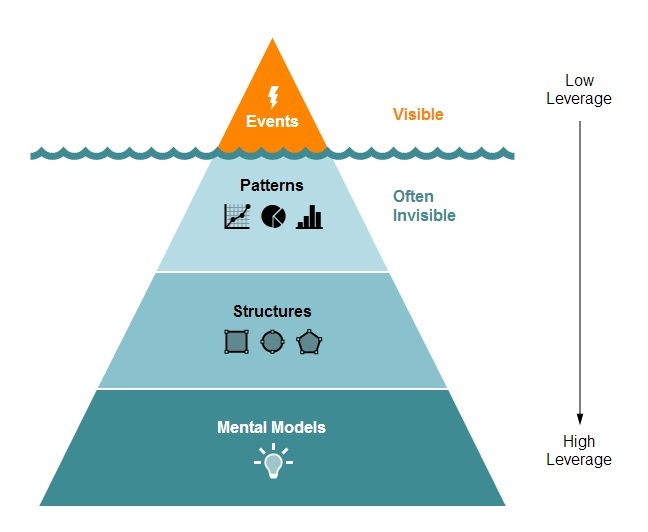
    Situations when culture becomes a liability:.CULTURE AS A LIABILITY - DYSFUNCTIONAL ASPECT.This helps the organization to maintain the stability of the social system within it. Stability of Social System :Values and accepted standards laid down by the organizationalĬulture help ensure uniformity in the behavior of employees and minimize individualĭifferences.Collective Commitment :Common beliefs of the members generate a collectiveĬommitment towards the organizational goals.Organization uphold are different in different organizations this creates a distinct identity for Boundary Defining Role : The values, traditions, rituals, etc., that members of a particular.Culture refers to a pattern of learned behaviors that is shared and passed on among.Culture, is understood as the customs, beliefs, norms & values that guide theīehavior of people in society & that are passed on from one generation to.Organizational culture, ICEBERG MODEL OF CULTURE: Creating and Sustaining Culture in an Organization, Countries and cultures, Difference in cultures


    Iceberg model examples


0 Comments


Leave a Reply.

    Author

    Write something about yourself. No need to be fancy, just an overview.

    Archives

    August 2023

    Categories

    All

    RSS Feed

Powered by Create your own unique website with customizable templates.
  • Blog